01 The deck and the deal
32 cards — 8 through ace in every suit, plus the 7♦ and 7♣, and the two cards
the whole game turns on: the 3♠ (worth −3) and the 5♥ (worth +5).
Four players in two teams, partners sitting across from each other. The whole
deck is dealt — eight cards each — so every card is out there, every hand.
02 The bid
At the start of a new game, the server randomly chooses the first dealer; the deal then moves one chair clockwise after every hand. Starting left of the dealer, everyone gets one chance: bid 7 to 12,
or pass. You're promising the points your team will take this hand — and you can
call it in a suit or in no trump, which beats the same number with trump
(and doubles the score, both ways). The dealer goes last with the old privilege:
they only have to match the high bid to take it away. And if the other three
all pass, the dealer has to bid — no free hands.
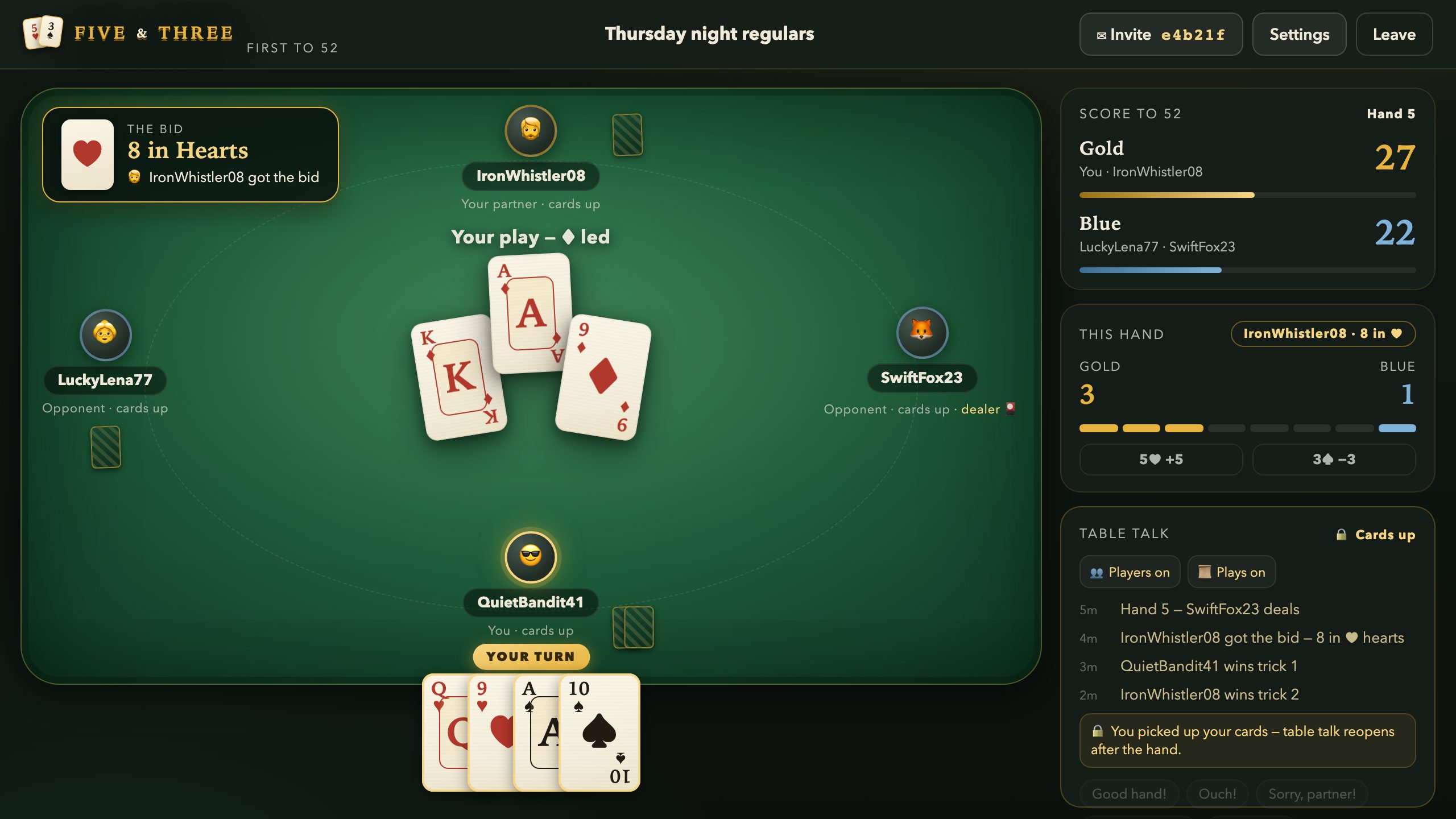
When it settles, somebody has the bid, and it sounds the way it always has:
“Who got the bid?” “Lena — eight in hearts.”
03 Playing the hand
Whoever got the bid names trump (unless they called no trump) and leads the
first trick. Follow suit if you can; out of the suit, play anything —
including trump. The trick goes to the highest trump in it, or to the highest
card of the suit led. Take a trick, and you lead the next one. Eight tricks
and the hand is done.
All the while, two cards are loose: get your team under the 5♥,
and dump the 3♠ on a trick the other side is winning.
04 Counting up
Every trick counts 1. The team that took the 5♥ adds 5; the team
stuck with the 3♠ loses 3. That's 10 points on the table every hand.
If the bidding team took what they promised, they score everything they took —
doubled at no trump. If they came up short, they go down: the bid
is subtracted instead (doubled at no trump). The other team keeps whatever
points they took either way.
Example: you got the bid at 8 in hearts and took 9 points — that's +9.
Take 7 and you go down 8.
05 Getting out
First team to 52 wins — and if both teams would cross on the same hand,
the bidding team gets out first. Sink to −52 and it's over. Once a team
reaches 47, they can only score while holding the bid — so the endgame is
always a fight for the bid.
06 How we talk at the table
“What's the bid?” — what's the number to beat.
“Who got the bid?” — who's naming trump.
“Eight in hearts” — the bid, said the way it's always been said.
“Made it” / “went down” — kept the promise, or paid for it.
“Took the five” — the bidding team won the trick with the 5♥ in it.
“Stole the five” — the defending team took the 5♥ away from the bidding team.
“Stuck them with the three” — played the 3♠ into a trick the other team won.
“Got stuck with the three” — won the trick containing the 3♠.
“Ran the table” — bid 12, took every point. Frame it.
07 Online tables, hosts & leaving
Table colours describe the room: gold is casual, blue is ranked,
red is private, and silver is a protected beta table. Open seats
means the game has not started and is still gathering players. Live
means a game is underway: jump in only when a chair is available, or watch
a full public table without seeing anyone's hand.
Public tournament matches are watchable too. Anyone who can see a
public event can watch its live matches even when all four human seats are
occupied. Private tables and private tournaments stay hidden from unrelated
players; only admitted participants and staff can see a private event.
Ownership follows the people who arrived. If a host leaves, control
passes automatically to the earliest remaining seated human; the departing
host cannot choose a favourite and a bot can never own a table. A host may
close a waiting private room, but cannot close a live game on another human.
Ranked games protect the players who stay. Auto-Play covers a dropped
seat while its reconnect window runs, and that seat stays reserved for the
original player — a fifth player can watch, but cannot inherit somebody
else's hand or rating. A departure before anyone reveals a
hand ends immediately as a remake: ratings do not move, but the departure is
still recorded. After play is revealed, a confirmed quitter alone takes the
rating loss; every player who stayed receives a zero-rating Forfeit Win or
Protected Result.
You may sign in on more than one device, but only one can control a table
seat. Opening your current table on another device transfers the seat there
and returns the older device to the Clubhouse. This makes phone-to-computer
handoff easy without letting one account play the same seat twice.
A rematch is a new agreement. Ranked tables require all four current
humans to approve. Casual and private tables require every current human;
bots do not vote, and a solo practice player can restart immediately. You
choose Stay in this chair to keep your exact seat for the next game, or
Leave room to release it. If anyone leaves or a seat changes, every
approval resets and the new lineup decides again. Spectators may stay to watch
the next game and, when a chair is available, choose it themselves. After a
completed game, the host may leave and pass ownership to the longest-seated
remaining human, or close the table for everyone. Closing never erases the
completed result or its rating changes. If the host opens the Clubhouse in
another window, their private-table card offers Return to your table
and Close table; invite codes remain hidden from everyone else.


Sign in to find your tablemates.
Friend requests and direct messages stay with your account.